
How can AI help you check an app before accepting delivery?

Give AI your agreed requirements and ask for test scenarios with a starting situation, an action and an observable expected result. Have a business owner review those expectations, then run the checks in a test environment and record the evidence. AI can help prepare the checklist; a generated checklist is not proof that the application works.
This is useful when you are receiving a booking system, customer portal, internal tool or custom automation. The demo may look right while an ordinary exception—such as a repeated request or insufficient stock—still produces the wrong outcome.
What is a user acceptance test?
A user acceptance test, often called UAT, checks whether an application supports an agreed business need in a concrete situation. For a stock-reservation tool, “the screen looks correct” is too vague. “With five units available, reserving two leaves three available and creates one reservation” can be checked.
Keep three things separate: the requirement states the rule; the scenario describes how to check it; the actual result records what happened during execution. A scenario can be well written and still fail when run.
If the underlying rule is unclear, first clarify the brief and its missing decisions. Here we start after the business rules have been agreed. We are checking delivery, not asking AI to invent the scope.
Which route should your team use?
1. A chat and a short manual checklist
For one small workflow, paste a sanitized requirements excerpt into an approved AI chat. Ask for a table you can copy into a document. Claude also supports TXT, DOCX and PDF attachments through the chat’s plus button. Check extracted content: embedded images in non-PDF documents are not read as images. These capabilities were verified on November 11, 2026, in the official file-upload documentation.
This proposed exercise needs no connector, scheduler or code execution. Use the chat access and usage allowance available in your organization; it does not depend on a specific paid tier or model. Upload only material permitted by your organization, without customer records, credentials or production access details. If your workspace does not allow the upload, use an approved text excerpt instead.
2. A shared test log for several reviewers
Keep the reviewed scenarios in the spreadsheet or work tracker your team already uses. Give each scenario a stable ID and an owner. Add columns for requirement ID, test data, expected result, actual result, status, evidence and application version.
Use “not run,” “passed,” “failed” and “blocked” consistently. An unavailable test account means blocked; it does not mean passed. A shared log is enough when the main problem is coordinating reviewers and making acceptance decisions visible.
3. Automated checks for frequently repeated flows
If the same scenarios must run after every release, ask the development team to implement a small automated suite. Codex or Claude Code can be considered as implementation assistants within the team’s approved development setup; this is an implementation option, not a claim that a chat-generated scenario is already executable.
A connector or MCP integration is relevant only if the workflow genuinely needs to read requirements or write test records in another system. It does not provide a schedule by itself. A scheduled check needs a runner, a test environment, an owner and a failure notification. Start with read-only access where possible and separate test credentials from production credentials. Have a person approve any expansion to actions that change business data.
For a single handover, the first or second route is usually sufficient. Automation becomes useful when repetition makes maintaining the tests worthwhile.
How do you turn a requirement into a useful scenario?
Use the simple structure given a situation, when an action happens, then expect an observable result. This follows the context/event/outcome structure described in the Gherkin reference. You can use it in plain language without installing Cucumber. Executable Gherkin requires step definitions connected to code; writing the words alone does not execute a test.
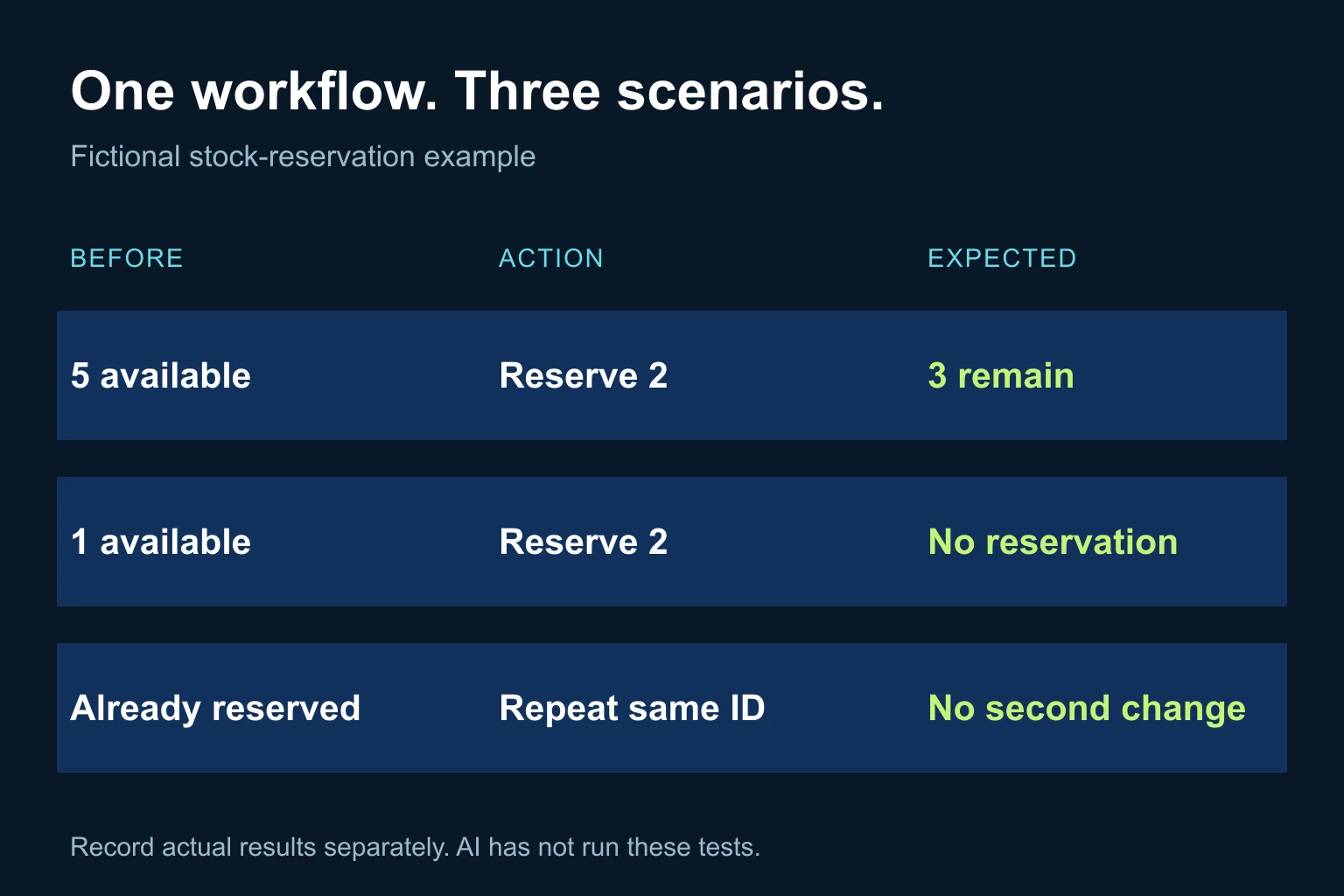
Here is a fictional example, not a customer result. An internal tool has these agreed rules:
- R1: A reservation may not exceed available stock. A rejected request must leave stock unchanged.
- R2: A successful reservation reduces available stock by the requested quantity and creates one reservation record.
- R3: Repeating the same request ID must not create a second reservation or reduce stock again.
With five units available, reserve two and expect three remaining plus one reservation. With one unit available, request two and expect rejection, one unit remaining and no reservation. After a successful request, repeat its ID and expect the original reservation with no further stock change.
The third rule must come from the agreed specification. If it is absent, AI should flag an unanswered decision about repeated requests, not silently add a new contractual requirement.
What prompt can you copy?
Replace the bracketed fields with an approved excerpt. Ask for a small first batch so the business owner can review it carefully.
Help me draft acceptance tests for [application/workflow].
This is planning only. Do not access systems or execute actions.

Agreed requirements, each with an ID:
[paste sanitized requirements]

User roles and test environment:
[paste approved context, without credentials]

Create up to 8 scenarios. For each, provide:
- Scenario ID and exact requirement ID
- Starting state and fictional test data
- Action to perform
- Observable expected result, including what must not change
- Evidence the reviewer should collect
- Priority and the business reason for it

Include normal use, an invalid input, a permission boundary and a
repeated action where the requirements support them.
Do not invent behavior. Put missing or contradictory rules in a
separate questions list. Label any suggested additional test as a
proposal requiring approval.
Leave actual result blank and status “not run” for every scenario.
Finally, list requirements that have no scenario.
The last instruction helps spot omissions. It does not prove complete coverage. A reviewer still needs to compare the scenarios with the source requirements and the way people actually work.
How should you run and review the checks?
- Freeze a small scope. Choose one workflow, the agreed requirements version and the application version being reviewed. Name the person who can accept or reject delivery.
- Review expected outcomes before execution. Remove vague wording such as “works correctly.” Resolve unanswered rules with the owner. Do not derive the expected outcome from whatever the current application happens to do.
- Prepare isolated test data. Use fictional records and dedicated test accounts with only the necessary roles. Disable real customer messages and payments or use the relevant sandbox. Confirm the environment before clicking anything that changes state.
- Run the scenario and collect evidence. Record the starting data, action, actual outcome and a relevant screenshot or test log. Check the underlying record when a visual success message does not establish the business outcome.
- Triage differences. Separate a defect from a changed requirement or an environment problem. Assign an owner and retest after a fix, including nearby scenarios that the change could affect.
- Make an explicit acceptance decision. Review failed, blocked and unrun critical scenarios. Record any accepted exception, who approved it and its follow-up date. A polished AI summary must not erase unresolved failures.
Do not ask a bot to test a live lead form by sending a real enquiry, or to validate a payment by making a real purchase. Agree on a test route with the development team. For sensitive actions, keep human approval at the point where the action could affect real records.
When is a checklist enough, and when can Ergonya help?
A reviewed checklist and shared log are often enough for a small application handover. You do not need to build a custom AI system merely to generate test cases.
Ergonya becomes relevant when the workflow crosses several systems, the business rules are difficult to make observable, or repeated releases need maintained automated checks. The useful deliverable is a clear connection between requirements, test evidence and the person making the acceptance decision.
Talk to Ergonya about AI transformation with one workflow, its agreed requirements and the outcome you need to verify. We can help define a focused pilot and decide whether your existing tools are sufficient or a tailored implementation is justified.