
Claude Frontier Academy: who should lead AI in your business?

Choose the person who can turn one business task into a checked, usable workflow—not simply the person who uses AI most often. Anthropic’s new Claude Frontier Academy makes this a timely question. For a smaller business, the immediate decision is usually about responsibility and a bounded pilot, not enrolling the whole team in another course.
Below we separate the announcement from our suggested action plan. Programme information was checked on 3 October 2026. The pilot is an original hypothetical example, not an Academy exercise or a reported client result.
What did Anthropic announce?
On 2 October 2026, Anthropic launched Claude Frontier Academy with a $100 million commitment and a goal of training 10,000 Frontier Deployed Engineers by the end of 2027. That is a target, not a count of graduates. Participation is by organisational nomination; eligibility enquiries go through an Anthropic account team or Partner Account Manager. Official announcement.
The initial programme is for experienced, hands-on software engineers. It combines four days of in-person training and assessment with a 12-week deployment residency. The final credential requires another assessment; first awards are expected in early 2027. It starts with enterprise customers and partners, not open self-service enrolment. The separate Claude Academy is listed as open to everyone. Programme details and learning alternatives.
Do not assume that buying a Claude subscription secures a place. Confirm eligibility, dates, location and any participation costs directly before planning travel or allocating staff. This article does not imply that Ergonya participates in the programme or holds its credentials.
What does this mean for a smaller business?
Our practical takeaway is to separate knowing the work from building the system. One employee may understand every exception in your order process without being a developer. An engineer may build a reliable integration without knowing which customer promises your team is allowed to make. You need both perspectives, even if one person covers both roles.
An AI project owner is the named person accountable for the scope, acceptance criteria and decision to continue or stop a pilot. They do not have to write every line of code. They do need the authority to obtain approved sample data, involve the right reviewer and prevent an unfinished experiment becoming an everyday dependency.
Ask a prospective owner or implementation partner to show you a failed test and explain the fix. A polished demo alone tells you little about what happens when information is missing or a connection breaks.
Which of three routes fits your team?
1. An internal champion using an approved product
Use this route when someone performs an occasional task and checks the result before using it. The owner should understand that task and be able to document the input, prompt and review steps. Start in your existing approved business AI account with fictional material. Check available features and your organisation’s data policy rather than purchasing a new tool immediately.
Training should end with a repeatable worked example that a colleague can follow. If the result is useful without connecting other systems, stop there. A developer is not automatically required.
2. A process owner paired with an integration specialist
Choose this when the same work must move between applications. Ask for a map of what is read, what is written and which identity grants access. Begin with a test folder or sandbox record, not unrestricted production access.
A connector or MCP connection provides access to tools or data; it is not a scheduler. A recurring workflow also needs a trigger, failure handling and duplicate protection. Agree who receives a failed-run notification and who can restart it safely before scheduling anything.
3. A business owner paired with a software engineer
Consider a custom build when an existing product cannot represent the required permissions, review steps or business rules. Ask for testable acceptance criteria, a small deployment boundary and a documented handover—not a promise that an autonomous agent will handle everything.
The choice between these routes should follow the pilot evidence. It should not depend on whether the supplier prefers selling courses, subscriptions or development.
What pilot could we run next week?
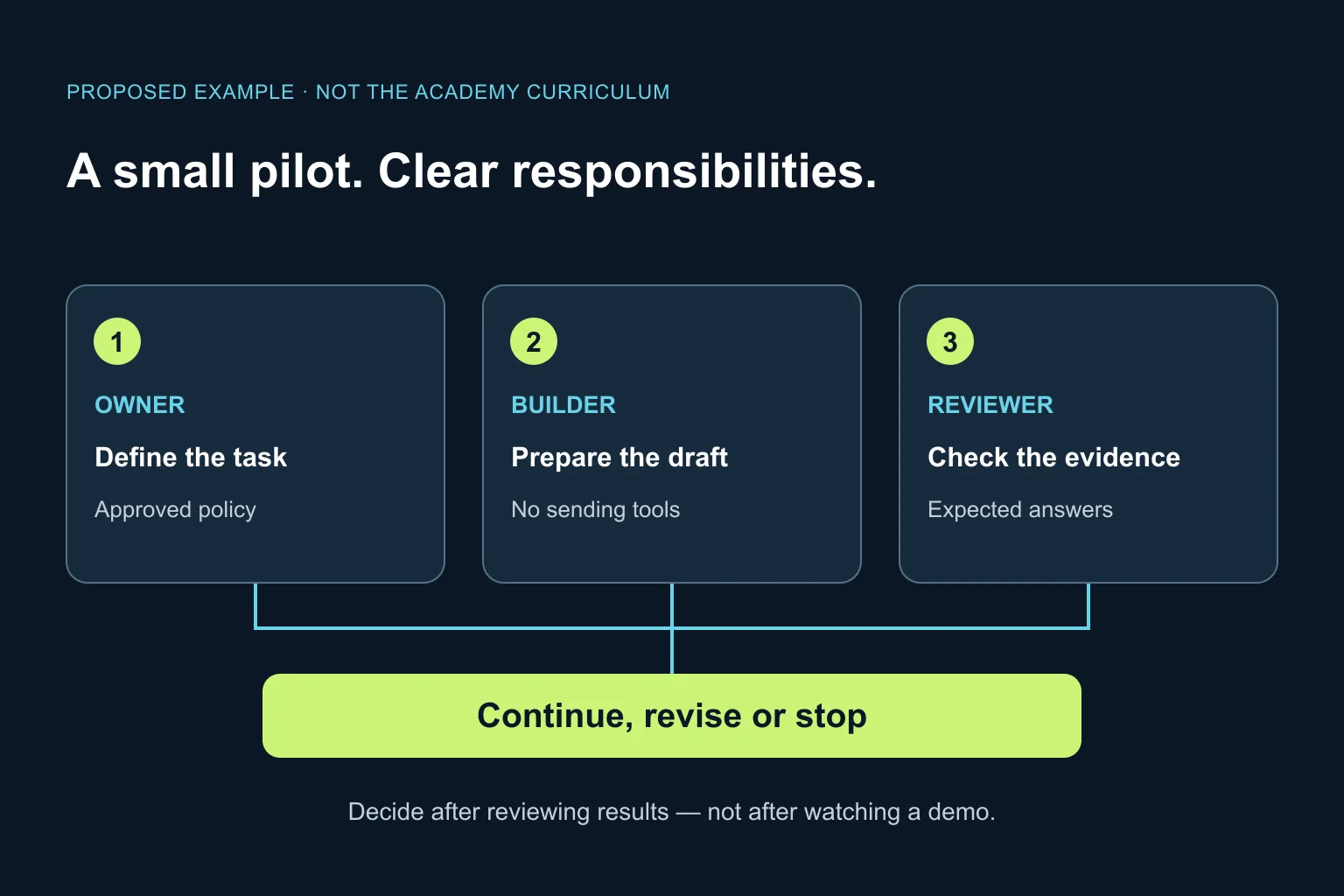
Here is a proposed internal support-drafting pilot. It does not send messages to customers or change orders. Its purpose is to test the working relationship between the process owner, builder and reviewer.
- Choose a narrow scope. Prepare draft answers to delivery-policy questions using one approved, dated policy sheet. Exclude refunds, account changes and payment actions.
- Name the reviewer. The customer-service lead writes expected answers before the builder sees the test results. The owner decides whether the draft is usable.
- Prepare a fictional test set. Include an ordinary question, an unanswered question, contradictory policy text and a request to ignore the policy. Keep customer identities out of the pilot.
- Define observable pass conditions. An answer must point to the relevant policy section. Missing or conflicting information must lead to review, not a confident invented promise. No external action is permitted.
- Compare with the current method. Record time to obtain an acceptable answer, corrections required and unresolved cases. Include review time; a fast draft that takes longer to repair is not a saving.
- Make a small decision. Continue, revise the scope or stop. Do not expand permissions merely because the ordinary example worked.
An evaluation is a test with an input and defined success criteria. Anthropic’s evaluation guidance distinguishes a system’s claimed answer from the actual resulting state and recommends repeated trials because outputs vary. Apply that distinction here: a statement that “nothing was sent” is weaker evidence than a pilot with no send capability. Agent evaluation guidance.
What should I ask for at handover?
Request a short, usable handover pack:
- The exact task, exclusions and person accountable for it.
- Approved inputs, their owner and how outdated material is replaced.
- Test cases, expected answers and unresolved failures—not just the best outputs.
- Accounts and permissions required, with a named administrator who can revoke them.
- Instructions for running, reviewing, stopping and recovering the workflow.
- The operating costs observed during the pilot and how future usage will be monitored.
Then ask a colleague who did not build it to follow those instructions. Where they get stuck, the handover is unfinished. This is a practical acceptance exercise, not a certification requirement.
What can I do today?
If your organisation may qualify for the Academy, contact its Anthropic account team with a named engineer and a concrete project, and ask about the actual requirements. Otherwise, you can still define the pilot above and choose the smallest suitable implementation route. You do not need to wait for a badge to clarify ownership.
For a one-person, reviewed task, an existing tool and good instructions may be enough. If several teams, systems and approvals are involved, Ergonya AI transformation can help turn the business need into a bounded implementation brief.
Discuss one AI pilot with the task your team repeats, the systems involved and who currently approves the result. The useful first outcome is a clear test and an accountable owner—not another impressive demo.