
Sonnet 4.5 retires on November 30: will your automations keep working?
Ask whoever maintains your AI workflows to identify the exact model and provider, then test affected integrations before their retirement deadline. Include background jobs and supplier-managed tools, not just the chatbot your team sees. The useful outcome is a list of working replacements with owners and evidence.
Anthropic announced on 30 September 2026 that claude-sonnet-4-5-20250929 is scheduled to retire from the Claude API on 30 November 2026. Its recommended replacement is claude-sonnet-5-5; retired-model requests fail. These facts were checked on 4 November, not announced today. Partner-operated platforms can have different schedules. Official retirement record.
Does this affect my business?
Start with the integration owner. This API notice does not establish a deadline for your team’s Claude chat subscription. If you buy a finished application, ask its supplier which backend it uses and whether an update is required from you. If your business runs its own integration, the person responsible for its configuration needs to check it.
A model retirement is the end of availability of a particular model through a service. A migration includes the configuration, behaviour and operational checks needed to move a workflow to another supported model. Changing a label in a settings page is only one possible step.
Make a small inventory with five fields: business task, provider, model identifier, owner and what happens if the task fails. Add scheduled reports, dormant seasonal campaigns, retry queues and fallback configurations. A workflow that has not run this week can still matter next month.
For direct API usage, Anthropic documents a Console Usage export with an API-key/model breakdown. Ask someone with the appropriate account access to obtain it; do not share API secrets in the inventory. Usage audit instructions.
Which route should I take?
1. Ask the supplier of a ready-made product
Request a short written answer: is this workflow affected, who performs the change, when will it be available, and what should your team test? Agree a contact for failures. If the supplier handles the infrastructure and the updated product passes your business checks, you may need no custom development.
2. Update an automation you manage
Have the authorised owner inspect the AI step and any fallback branches. Duplicate the workflow into its test environment where supported, disable real deliveries and use synthetic inputs. A connector or MCP determines access to tools; a schedule determines when the job runs. Neither proves that the configured model remains available. Check both the AI step and what happens afterward.
3. Have a developer migrate custom code
Record the model ID, API version, SDK version and relevant request settings before changing them. Anthropic distinguishes newer dateless model IDs from older convenience aliases; a dateless name is not automatically a pointer to the newest model. Inspect the actual identifier rather than inferring it from a friendly interface label. Model IDs and versioning.
The current Sonnet 5.5 migration guide covers more than the model name: older thinking settings, assistant prefills and forced tool choice can require changes; response parsing also needs review. Have the developer follow the checklist for the starting model and test the complete workflow. Official migration guide.
What should a meaningful test look like?
Consider a fictional quotation-drafting workflow. It reads an approved enquiry, proposes a draft and waits for a salesperson. Its replacement is acceptable only if it preserves required fields, flags missing quantities, avoids invented prices and leaves delivery pending approval. An elegant paragraph alone is not a pass.
Use a compact set of cases: a complete request, missing information, contradictory information, a malformed input and a provider failure. Write the expected outcome before running each case. Keep the original inputs and compare results under the same rules. Count failed validations and manual corrections, and measure actual elapsed time and usage in your environment. Do not assume a newer model meets your budget or response-time needs.
| Test | Evidence to keep |
|---|---|
| Required output fields | Saved result and validation outcome |
| Missing or conflicting information | Clear review request instead of a guess |
| Tool or provider failure | Visible failure and a recoverable work item |
| Repeated execution | No duplicate external delivery |
Keep test credentials limited to the sources and outputs needed. During the pilot, retain human approval for customer messages and other consequential actions. The AI quotation guide explains the business review stage; this article focuses on continuity when a dependency changes.
What can we do this week?
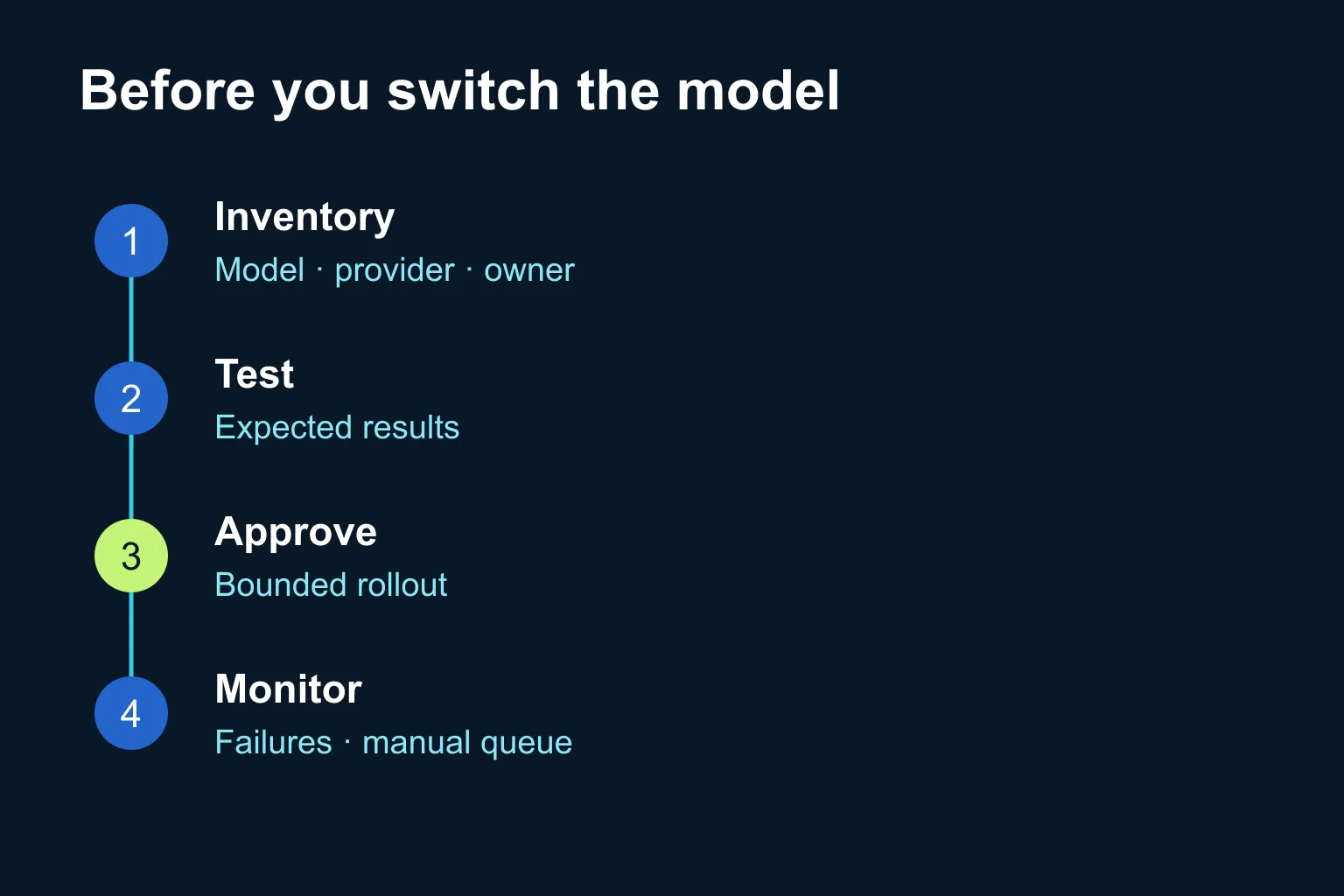
- Assign one accountable owner and list affected workflows with their provider-specific deadline.
- Ask suppliers for their plan; give developers the relevant migration documentation.
- Agree acceptance cases and test with external actions disabled.
- Release one bounded workflow after review, then inspect its first real runs.
- Define who receives failures and how unfinished work enters a manual queue.
Prepare the contingency before switching. A previous configuration is useful only while its dependencies remain supported. A manual queue or a separately tested supported route is a more credible post-retirement contingency than an assumption that the old model can always be restored. Keep enough non-sensitive failure context to resume the work without resending completed actions.
When does Ergonya help?
An accountable supplier and a small acceptance test may be enough for one ready-made tool. Ergonya helps when several automations, codebases or providers share an undocumented dependency and nobody owns the whole journey. Discuss an automation continuity review with a list of workflows and their owners. The first deliverable should be a dependency map, test plan and release order that your team can act on.