
Agent Skills joins AAIF: can your business move its AI workflows?

A shared skill format can make your business instructions easier to reuse across AI tools. It does not transfer account access, permissions or a guarantee of the same result. Start by moving one small procedure and testing it against known examples before connecting it to live operations.
On 22 October 2026, Anthropic announced that it was donating Agent Skills to the Agentic AI Foundation (AAIF), under the Linux Foundation. The announcement covers the standard’s name and logo, GitHub organisation and domain. This article examines that change on 29 October, rather than presenting it as a new announcement today. Read the original announcement.
For a business owner, the useful question is practical: if your team changes AI tools, how much of its working method can it keep? A carefully maintained procedure is an asset. Recreating it from someone’s chat history every time is avoidable work.
What changed, and who should care?
The announcement gives the standard a foundation home. It also describes versioned releases, a formal proposal process and security guidance as a proposed roadmap, not a completed set of new features. Using or contributing to the standard does not require joining AAIF. Source: Anthropic.
This matters most to teams already maintaining repeatable AI procedures: checking project briefs, preparing internal reports or reviewing documents against a house standard. It is less urgent if you ask an assistant a different one-off question every day.
Our practical interpretation is to separate the business method from the application around it. Keep the procedure, examples and acceptance criteria in a controlled package; document each tool’s dependencies separately. A governance announcement is a reason to review that structure, not a reason to replace a tool that already works.
What is an Agent Skill?
An Agent Skill is a directory with a SKILL.md instruction file and, optionally, supporting resources or scripts. The specification requires a name and description in the file’s metadata. It also provides a compatibility field for environment requirements. The optional allowed-tools field is experimental and may behave differently between implementations. Agent Skills specification.
In business terms, think of a packaged working method: when to use it, what information it needs, how to perform the task and what a good result looks like. Portability means you can reuse that package in another compatible environment; operational readiness means you have checked that the environment can actually carry out the task correctly.
Does this give every employee the same features?
No universal subscription or installation entitlement follows from the announcement. Before a pilot, have the tool owner verify the specific product, plan, installed version, skill-loading method and organisation policy. Record the verification date. If installation requires an administrator, include that person before the test.
This guide does not provide a universal “click here to install” sequence. Product interfaces and support differ. A package that only contains instructions may need little setup; one that invokes a script or reads an internal system has additional dependencies. Microsoft’s Agent Framework documentation explicitly distinguishes runtime skills in an application from skills used to guide a coding assistant. Microsoft documentation.
Keep four responsibilities separate:
- Skill: describes the method and expected output.
- Connector or MCP integration: provides an available route to a system or tool, subject to its permissions.
- Bot or scheduler: decides when a run starts and how failures are reported.
- Application controls: enforce access, review and logging around the run.
A skill file is not a scheduler. Copying it does not move credentials or authorise sending messages, changing records or publishing content.
Which implementation path should we choose?
1. Keep a reusable brief in your existing assistant
If the task is occasional and someone reviews every result, a saved instruction document may be enough. Keep a clear input template, examples and a checklist. There is no need to package executable code merely to standardise a short internal review.
2. Package one procedure for a compatible agent
When several people repeat the same task, put the method and reference examples in a version-controlled skill. Start with an instruction-only package. Have the tool owner check the current loading requirements, then run it on a small set of approved sample inputs. Keep the previous working version available.
3. Build an integration only when the workflow needs one
If the procedure must read approved records or run on a schedule, treat that as a separate implementation project. A developer can use a coding assistant such as Codex or Claude Code to help build the integration, but the resulting application still needs tests, restricted credentials, error handling and an owner. Reading a project brief is a different permission from updating its project record.
Choose this route because the volume or handoff requires it, not because the standard is in the news. A manual run with a reliable review step is often the better starting point.
What would a useful portability test look like?
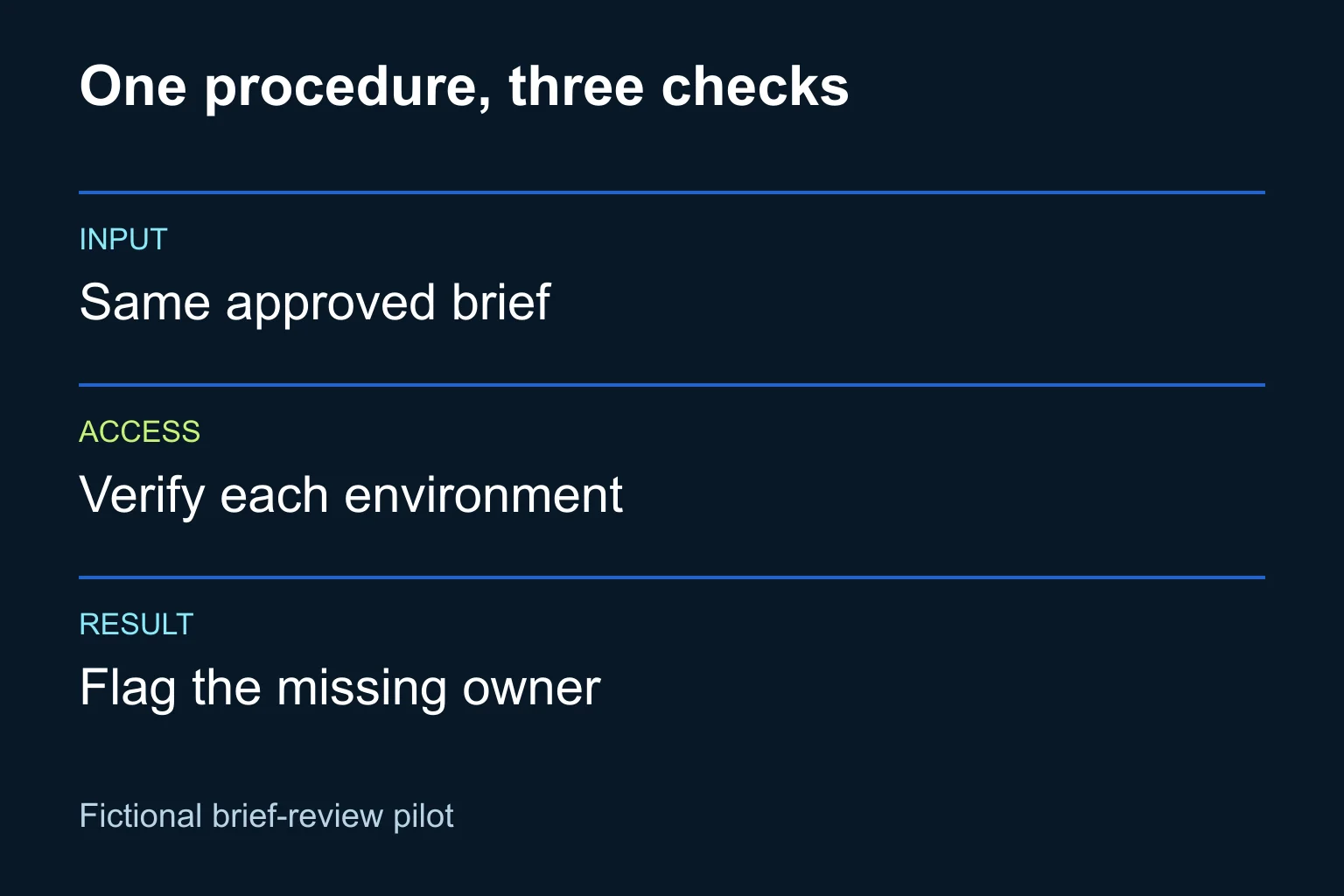
Consider a fictional project-brief review. The procedure should identify missing owners, dates and acceptance criteria, then return a review table. It must not create tasks or invent deadlines.
Use the same approved sample in both environments. In one sample, omit the owner. In another, include conflicting dates. Add a complete brief as a control. A successful result flags the omissions and conflict, preserves the stated facts and follows the requested output structure. Similar wording is not the success criterion.
Use this original prompt to prepare the test specification in your approved assistant:
Review the procedure below for a move to another AI environment. Do not execute scripts, connect accounts or change files.

Separate: business instructions, required inputs, external tools, permissions, output format and human review points.

Create three fictional test briefs: one complete, one with a missing owner, and one with conflicting dates. For each, state the expected findings and a clear pass/fail rule. Do not invent a resolution for missing or conflicting facts.

List every environment dependency that the tool owner must verify. Mark unknowns as pending. Finish with a proposed pilot checklist, not an installation command.

Procedure: [paste the approved method without private data]
What should we check before using a downloaded skill?
Review the whole package, including scripts and referenced resources, and verify that code does what the description claims. Prefer a known author and a recorded version. For executable components, restrict filesystem and network access and require human confirmation for sensitive actions. These precautions follow Microsoft’s guidance to treat third-party skills like other third-party code. Security guidance.
For your own pilot, record which files and systems are permitted, which actions are prohibited, who reviews the output and how to stop the run. A written “do not send” instruction is useful, but removing unnecessary send permission gives you an additional control.
What can we do this week?
- Choose one bounded task. Prefer an internal review with no external writes.
- Name its owner. That person approves both the method and its expected results.
- Inventory dependencies. Record product, plan, version, access and required scripts; leave unverified items pending.
- Run the same sample set twice. Compare findings and failure behaviour, not just the polished answer.
- Approve a limited rollout. Keep a version record, review exceptions and retain the previous procedure.
If your process is still mostly unwritten, first turn real working notes into an SOP. If your main difficulty is finding reliable internal evidence, start with company-document search. Packaging an unclear method will preserve its ambiguity too.
Ergonya can help you choose a first reusable workflow, define its acceptance checks and connect it to your systems when that adds value. Discuss a practical AI transformation pilot, starting with one process your team already understands.