
IBM and Microsoft announce Imagine Enterprise: does your business need it?

Imagine Enterprise is worth investigating when your problem involves operating agents across business systems, with clear responsibility for access, monitoring and support. For one small task, first check whether an existing tool or a bounded integration is enough. Buying a larger platform before defining the process makes it harder to judge what you actually need.
What changed on November 10?
IBM and Microsoft announced Imagine Enterprise on November 10, 2026. IBM describes access through an IBM Consulting engagement, including operated deployments or co-innovation, with self-management options also available. Initial industry frameworks cover financial services, insurance and retail. These are announcement facts checked on November 12, not a claim that every customer can activate a ready-made solution today. See the official announcement.
An enterprise agent platform coordinates AI-assisted work and its connections to organizational systems. The practical question for a buyer is who owns each workflow, what it may change and how a failed action is detected.
Is this included in a Microsoft subscription?
Do not assume so. The announcement’s engagement route does not establish entitlement under your existing licenses. Request a written proposal for your organization, region and intended deployment.
IBM’s product overview describes Microsoft Foundry and Copilot Studio for coordination, and Entra, Purview and other Microsoft technologies for identity and governance. That is a description of the offering, not proof that your tenant already has the required permissions or configuration.
Before planning activation, ask for the exact license requirements, implementation responsibilities, supported integrations, data-processing locations, administrator roles and operating costs. No public price or universal rollout date is asserted here. A product announcement is not your implementation plan.
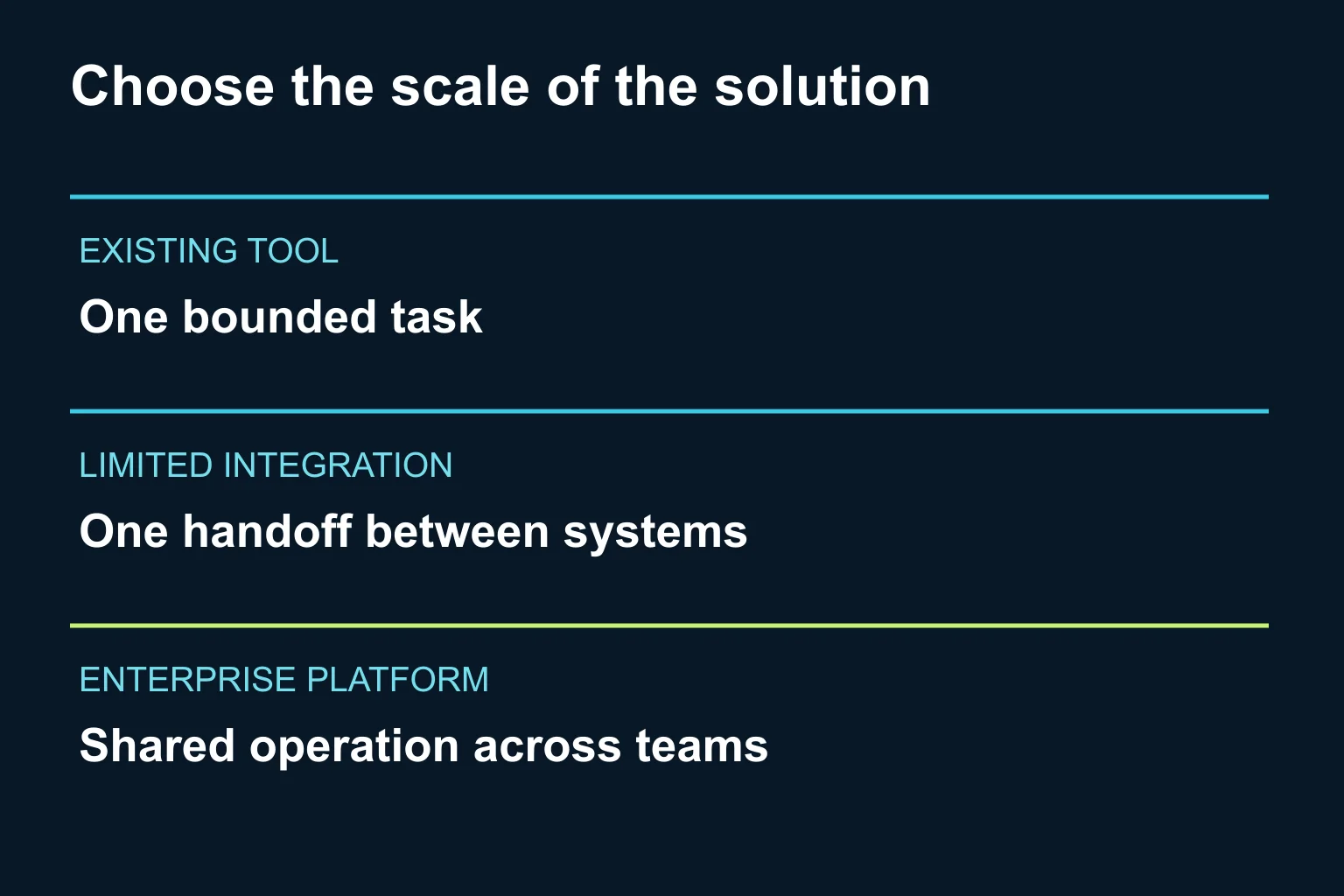
Which of three routes should you compare?
Use an existing product for a bounded task. If the need is to summarize approved documents or prepare a draft for review, test the tools already available to the team. Keep the input narrow and check the output against its source. A new enterprise platform may add little to that single task.
Connect a limited workflow when the handoff is the problem. If staff repeatedly copy an approved result between two systems, first document that transfer. A connector or MCP connection may provide access; it does not itself define a schedule, ownership or recovery procedure. For a recurring bot, specify the trigger, permitted actions, error handling and person responsible for failures. Custom implementation can be considered after those decisions, without assuming it is necessary.
Evaluate an enterprise platform when shared operation is the problem. Multiple teams, systems and approval paths may justify a coordinated platform evaluation. Ask the supplier to demonstrate your particular workflow, including an exception and a denied action. Compare the proposed operating model with a smaller alternative using the same acceptance criteria.
These are proposed buying paths, not a benchmark or an endorsement of one supplier.
What would a small pilot look like?
Consider a fictional retailer reviewing supplier onboarding requests. Staff currently gather documents, check completeness and forward a recommendation to a manager. The pilot could prepare a completeness checklist from synthetic records. It should not create a supplier, change bank details or send a contractual acceptance.
The first useful result is a recommendation with traceable source references and an explicit list of missing information. A reviewer checks it before any downstream action. Record both correct and incorrect recommendations; do not report a polished demo as a proven productivity gain.
Agree on acceptance scenarios before testing the application. A missing document, a conflicting identifier and an unauthorized user are useful proposed cases to discuss with the process owner. They are not claims that a particular platform has passed those tests.
What should you do this week?
- Choose one process and name its business owner. Describe where work starts, where it ends and which decisions require approval.
- List the systems and data needed. Separate reading information from changing records; start the proposed pilot with the minimum access needed.
- Request deployment and licensing details in writing. Identify who configures identity, permissions, logs and recovery, and who pays for ongoing operation.
- Ask for a demonstration with synthetic data, including one failure and one blocked action. Keep critical changes behind human approval.
- Compare the existing-tool, limited-integration and platform routes against the same scope. Include implementation, maintenance, training and exit requirements, not just the initial subscription.
- Define a stop decision. If the pilot cannot produce a verifiable result or an accountable operating owner, resolve that gap before expansion.
This checklist is more useful for this announcement than a generic prompt: the unresolved questions concern your environment and supplier commitments, which a chatbot cannot confirm on their behalf.
When can Ergonya help?
An existing product may be sufficient if the task stays within one team and a clear review step. Ergonya can help when you need to map the process, separate necessary integration from unnecessary complexity, or design a small pilot with observable results.
Discuss your AI transformation workflow with Ergonya. Bring one process, the systems involved and the decision you want to improve. The aim is to identify a proportionate next step before committing to a larger implementation.